

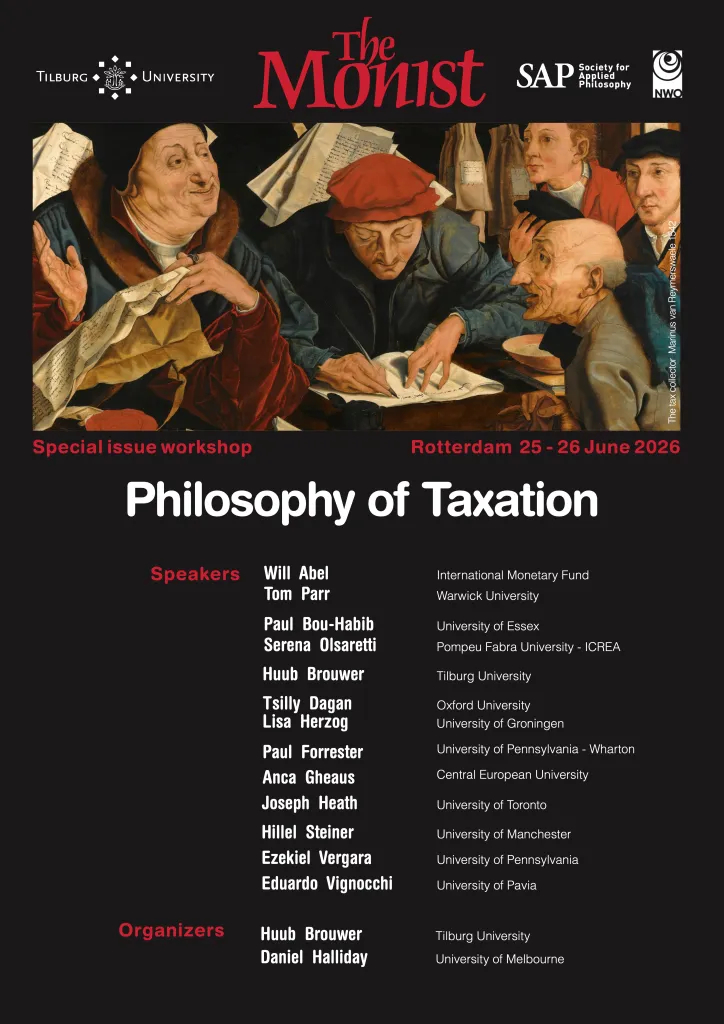
Philosophy of Taxation
Workshop for special issue of the Monist
25-26 June 2026
Erasmus University Rotterdam campus
Confirmed speakers
- Will Abel (IMF) & Tom Parr (University of Warwick) – on egalitarian land taxation
- Paul Bou-Habib (University of Essex) & Serena Olsaretti (ICREA – Pompeu Fabra University) – on taxation and migration
- Huub Brouwer (Tilburg University) – on the tax base for limitarianism
- Tsilly Dagan (Oxford University) & Lisa Herzog (Groningen University) – on taxation and the spatial and temporal scope of work
- Paul Forrester (Wharton, University of Pennsylvania) – on grandfathering in taxation
- Anca Gheaus (Central European University) – on sharing the costs of childbearing and childrearing through the tax system
- Joseph Heath (University of Toronto) – on wealth taxation
- Hillel Steiner (University of Manchester) – on UBI and the case for land value taxation
- Ezekiel Vergara (University of Pennsylvania) – on tourist taxation
- Edoardo Vignocchi (University of Pavia) – on taxation as a constitutive practice and the buy, borrow, die strategy
Topic
Taxation was largely overlooked in 20th century political philosophy. This is a shame, because taxes are a powerful driver of human behaviour and mould the world around us. Think only of the window taxes that shaped architecture in European countries in ways still visible hundreds of years onwards. In the 21st century, philosophers have fortunately started toengage with questions of taxation again. However, an important and normatively significant issue that has not received sufficient attention yet is the choice of tax base: what should be taxed?
Many countries predominantly tax labour income and consumption. Developments in the real economy – including slower economic growth, labour market polarisation, and the growing concentration of wealth – have put a strain on fiscal policy formed largely in the years just after 1945. Moreover, even though taxation has strong effects on human behaviour, governments have so far only used it sparsely to address contemporary challenges such as climate change, disruptive technological development, and demographic ageing. These changes and challenges suggest a need to reform the tax base for it to be fit for purpose.
The aim of the workshop, and the special issue that will result from it, is to contribute to the cutting-edge of philosophical inquiry into taxation by studying which tax bases can help address 21st century challenges.
Special issue of the Monist
Papers presented at the workshop will be considered for inclusion in a special issue of the Monist, that will be published in April 2028 (volume 111, issue 2).
Registration
This event is open to all who are interested in attending. To sign-up to attend, email Huub Brouwer (h.m.brouwer@tilburguniversity.edu). Unfortunately, online attendance is not possible. The workshop is pre-read: draft papers are pre-circulated and participants are expected to read them beforehand.
Funding
This event is funded by the Huub Brouwer’s Veni grant on philosophy of taxation (VI.Veni.221F.045) and the Society for Applied Philosophy.
More information